
X Launches History Tab to Organize Bookmarks and Media
CONTEUDO:
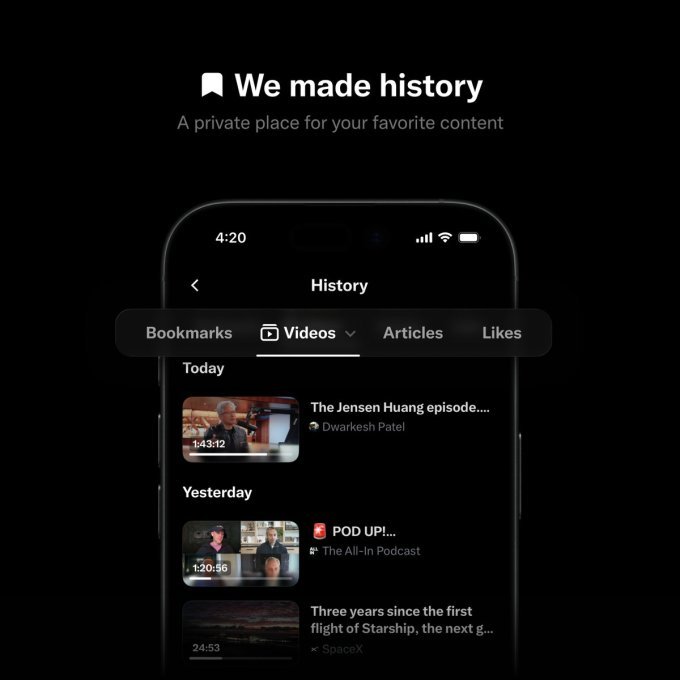
X is evolving its mobile interface to function more like a personal archive, introducing a new “History” tab that consolidates user activity. The feature, currently rolling out to iOS users, creates a centralized hub for bookmarks, likes, videos, and articles, streamlining how people revisit content.
Nikita Bier, head of product at X, explained that the update is designed to help users better track their favorite content, providing a more intuitive way to return to media or reading material they intend to finish later.
How the History Tab Works
The update replaces the existing “Bookmarks” button in the app’s left-side menu with the new “History” label. Within this section, the interface is organized into four distinct tabs:
- Bookmarks: Items intentionally saved by the user.
- Likes: Content previously interacted with via the heart icon.
- Videos: A collection of footage viewed within the platform.
- Articles: Long-form pieces read or accessed through X.
While bookmarks and likes represent deliberate saves, the videos and articles tabs automatically populate based on user consumption. According to Bier, this section remains entirely private, ensuring that a user’s browsing history is not visible to others.
Strategic Shift for Content Consumption
By grouping these features, X is adopting a structure reminiscent of a web browser, allowing users to trace their steps through the app. This change simplifies navigation, as these interactions were previously scattered—bookmarks lived in the main menu, while likes were sequestered within individual user profiles.
This development also signals a push for X’s long-form article format. By providing a dedicated space to track these pieces, the platform aims to turn itself into a personalized news aggregator. This is particularly relevant as web publishers face declining referral traffic from platforms like Google and Facebook due to algorithmic changes and AI-driven search results.
X is positioning itself to capture this lost traffic, encouraging creators and publishers to host their content directly on the app, where native discovery and distribution tools are readily available for posts that exceed the standard 280-character limit.