
Aura Ink Review: The E-Ink Frame That Looks Like Print
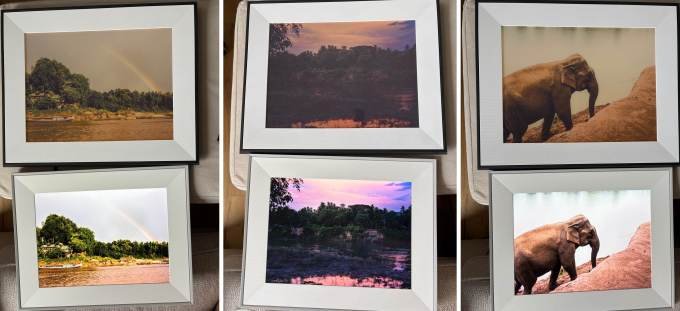
Digital photo frames have long struggled with a common identity crisis: they promise the elegance of home art but often deliver clunky, glowing screens that feel out of place. Aura is attempting to disrupt this cycle with its new Ink frame, a device that leverages color e-ink technology to create an display so subtle it is frequently mistaken for a traditional paper print.

The primary challenge for Aura’s engineering team was the inherent limitation of current color e-ink displays, which are restricted to a palette of only six colors: black, white, red, blue, green, and yellow. To overcome this, the company developed a proprietary dithering algorithm. This software blends the limited color set into patterns that the human eye perceives as smooth gradients, allowing for a surprisingly realistic image reproduction.
The Engineering Behind the “Magic”
Eric Jensen, co-founder and CTO of Aura, notes that achieving this level of visual fidelity required extensive testing across various lighting environments. “It’s all sort of theoretical and comes down to how people perceive it,” Jensen explained. The result, according to user feedback, is a device that often confuses guests, who frequently ask how a photograph could be printed and mounted so quickly.
Unlike standard LED screens that emit light and cause eye strain, the Ink frame functions similarly to an e-reader, offering a matte, non-glare surface. While the color reproduction isn’t identical to a high-resolution LED panel—or a professional darkroom print—the aesthetic trade-off is intentional. The device is designed to prioritize the “art” feel over pixel-perfect color accuracy.
User Experience and Connectivity
- App Integration: Users manage photos via the Aura app, which supports imports from iCloud, Google Photos, web, and email.
- Social Features: The platform allows for shared libraries, enabling family members to upload images remotely to a connected frame.
- Power Efficiency: The device includes a sleep mode for when the room is dark or unoccupied, requiring a USB-C charge roughly once a month.
- Refresh Rate: Photos typically cycle once per day. Manual updates trigger a one-minute rendering process to apply the dithering algorithm.
At a retail price of $499, the 13.3-inch Ink frame sits at a higher premium than the company’s $229 Aspen LED model. While the color palette may not satisfy purists looking for perfect white balance, it succeeds in its primary goal: transforming a digital device into a piece of decor that feels genuinely integrated into a home gallery.