
Roblox Rolls Out Agentic AI Tools for Game Development
Roblox is evolving its development ecosystem by integrating new agentic capabilities into its platform. The company is overhauling its Roblox Assistant—a natural language AI tool—to function as a collaborative partner capable of managing the entire lifecycle of game creation, from initial concept to final testing.
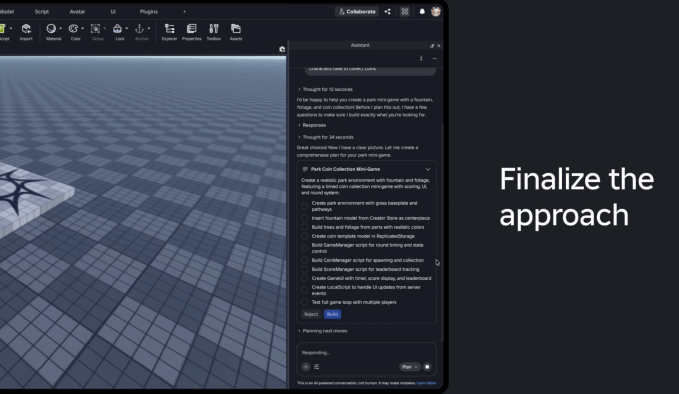
The core of this update is a revamped “Planning Mode,” designed to bridge the gap between a developer’s creative intent and the final output. Unlike traditional AI tools that execute prompts in a single, often rigid step, this new feature engages in a back-and-forth dialogue. It analyzes existing code and data models, asks clarifying questions, and structures user requests into actionable, editable development plans.
Accelerating Asset Creation and Testing
To support this planning process, Roblox is introducing two primary generation tools:
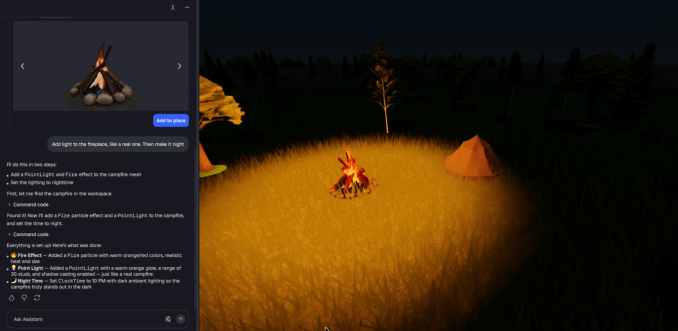
- Mesh Generation: Allows creators to produce fully textured 3D objects directly, eliminating the need for low-quality placeholders during the early stages of design.
- Procedural Models: Enables the creation of editable 3D assets via code and natural language, allowing for dynamic adjustments to dimensions and attributes.
The Assistant also incorporates automated testing. It can monitor output logs, capture screenshots, and simulate user inputs to verify gameplay mechanics. If a bug is identified, the system provides feedback to the Assistant, which then attempts to resolve the issue automatically.
“The launch of our agentic features in Roblox Studio reduces barriers between creative vision and execution,” said Nick Tornow, senior vice president of Engineering, in a statement. “Assistant works as a multi-step, collaborative development partner—accelerating the process of planning, building, and testing, so creators can get from idea to reality faster.”
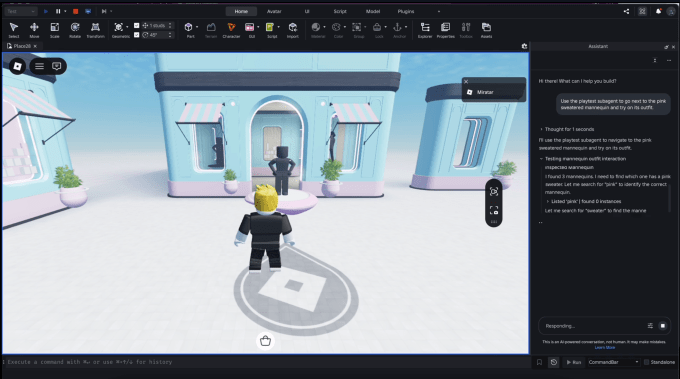
According to a blog post from the company, this creates a “self-correcting system” that improves in accuracy over time. Moving forward, Roblox plans to enable multiple AI agents to work in parallel, handle complex cloud-based workflows, and maintain interoperability with third-party tools such as Claude, Cursor, and Codex.