Google Chrome Accelerates Updates to Two-Week Schedule
Google is shifting its Chrome browser to a faster release cadence, moving from a four-week cycle to a two-week schedule. This change, announced by the company on Tuesday, signals an aggressive push to deliver stability, performance improvements, and new features to users at double the previous frequency.
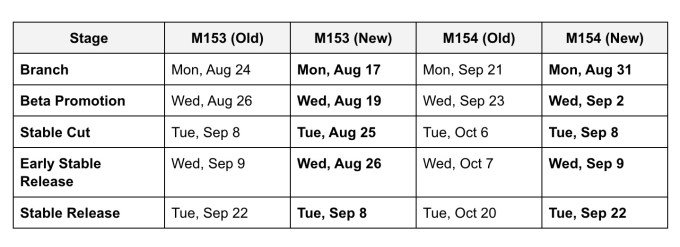
The updated new release schedule will take effect starting with version 153 of the browser on September 8, 2026. This transition applies across all primary platforms, including desktop, Android, and iOS. While the core release pace is quickening, Google confirmed that existing weekly security updates, which were launched in 2023, will continue as planned.
Adapting to a Shifting Browser Market
Google maintains that the change is intended to provide developers with faster access to modern web tools and platform advancements. However, the update coincides with intensifying pressure from AI-driven browser competitors. Companies like OpenAI and Perplexity are actively working to redefine the browsing experience by incorporating agentic capabilities—automating tasks on behalf of the user.
For instance, OpenAI’s ChatGPT Atlas integrates an AI assistant directly into the browsing experience, while Perplexity’s Comet utilizes a sidecar AI for features like meeting scheduling and email management. In response, Google has been aggressively embedding its Gemini AI into Chrome to provide similar autonomous task capabilities.
Exceptions and Stability
Not all versions of Chrome will follow this new two-week cadence:
- Early Release Channels: Dev and Canary channels will remain unchanged.
- Extended Stable: Enterprise administrators and Chromium embedders who require more predictable update windows will continue to use an eight-week cycle.
- Chromebooks: The Extended Stable option will remain a choice for Chromebook users.
Although Google stated that this acceleration is not specifically driven by AI competition, the industry-wide push toward an “agentic web”—where browsers perform complex actions rather than just displaying content—suggests that maintaining a rapid development pace is becoming a strategic necessity for the search giant.